


human rights
-
South Sudan: the Commission’s mandate remains crucial as the civil & political space continues to deteriorate.

Statement at the 52nd Session of the UN Human Rights Council
Enhanced Interactive Dialogue on the report of the Commission on Human Rights in South Sudan
Delivered by Nicola Paccamiccio
Thank you, Mr President,
CIVICUS and its South Sudanese partners welcome the report of the Commission on Human Rights in South Sudan. The Commission’s mandate remains crucial as the human rights situation worsens and the civil and political space continues to deteriorate.
Freedoms of assembly, association and expression are under severe threat. In the past year, South Sudanese authorities have continued, with impunity, to repress and harass peaceful protesters and civil society actors. Many are subjected to arbitrary arrests, detentions and extrajudicial killings.
Freedom of association remains severely restricted as civil society organisations are subjected to raids by the National Security Service and activists calling for good governance and the rule of law are harassed, intimidated and arrested. Journalists continue to face threats, intimidation, and arbitrary arrests resulting in self-censorship.
The high levels of localised violence and the increase of conflict-related sexual violence, including the use of rape and gang rape as a weapon of war, are of great concern. Nationally instigated intercommunal conflicts in Tonj, Warrap State, Magwi, Nimule and Kapoeta in Eastern Equatoria State, as well as in Greater Upper Nile State, and parts of greater Jonglei and Unity State are alarming. This situation is worsened by the numerous obstacles to humanitarian aid, reported intimidation and harassment of and attacks against humanitarian workers, including killings, and extrajudicial executions of prisoners.
In light of the ongoing restrictions on civic space in the country, we call on the Council to extend the mandate of the Commission for a further period of two years to ensure continued scrutiny on the human rights situation in the country and to enable it to comprehensively report on the election and transition process.
We thank you.
Civic space in South Sudan is rated as "Closed" by the CIVICUS Monitor
-
South Sudan: Widespread rights violations persist

Statement at the 48th Session of the UN Human Rights Council
Interactive Dialogue with the Commission on Human Rights in South Sudan
Delivered by Paul Mulindwa
CIVICUS and its partners in South Sudan thank the Commission on Human Rights in South Sudan for their update and this crucial continued scrutiny.
We welcome steps taken to implement recommendations of the Revitalized Peace Agreement. However, its implementation continues to be slow.
Despite renewed commitment towards the formation of the Government of National Unity, there is no improvement in the human rights situation. Dire humanitarian, food security, and economic conditions in the country continue to have an enormously detrimental effect on civilians. Localised violence continues unabated in many parts of the country. We are gravely concerned by reports of extrajudicial executions carried out by government forces in Warrap State in July of at least 42 people. Thirteen people were arbitrarily executed in June at the instruction of state officials in Cueibet and Rumbek East.
Civic space is closed, with independent and critical voices, including human rights defenders particularly targeted. The Commission has highlighted the troubling practice of surveillance of journalists and activists to instil fear. We continue to see restrictions on freedom of expression, peaceful assembly, and association; arbitrary arrest and detention; and sexual violence. The current arrests of activists and crackdown on peaceful protests in South Sudan is particularly concerning.
We call on the South Sudan government to take concrete steps to ensure human security and protection of human rights.
We ask the Commission what are the next steps that the Council and members states do to further accountability, as well as to enhance protection and promotion of human rights and fundamental freedoms?
We thank you.
Civic space in South Sudan is rated as closed by the CIVICUS Monitor
-
SPAIN: ‘The LGBTQI+ community fears both legal and social backlash’
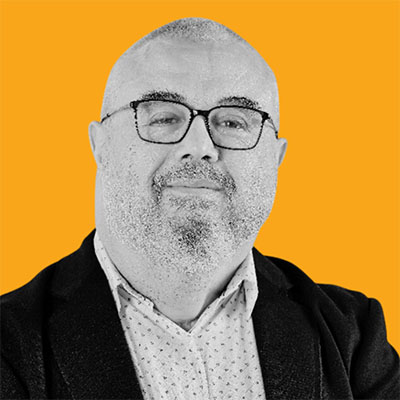
 CIVICUS speaks about the situation of LGBTQI+ people in the context of Spain’s election withEmilio de Benito, spokesperson for Health and Seniors of the LGTB+ Collective of Madrid (COGAM).
Founded in 1986, COGAM is a civil society organisation (CSO) working for LGBTQI+ equality. It is one of the founding organisations of the Spanish State Federation of Lesbians, Gays, Transsexuals and Bisexuals and one of the promoters of equal marriage, legalised in 2005.
What recent changes have occurred in the situation of LGBTQI+ people in Spain?
Following the approval this March of the Trans Law, the situation in Spain is, at least on paper, one of the best in the world. The Trans Law allows free choice of registered sex based solely on each person’s will, prohibits conversion therapies and imposes measures for diversity in education and employment.
We have a problem, however, namely the rise of hate speech propagated by the far right, represented by Vox, and even by the more traditional conservative party, the Popular Party (PP). This election campaign has been plagued by expressions of homophobia and transphobia. We have seen politicians refuse to address trans people in a manner consistent with their gender identity and threaten to abolish laws that have enshrined rights, such as the Equal Marriage Law and the Trans Law. This has reflected in an increase in harassment of LGBTQI+ people both in the classroom and on the streets. According to official data, last year hate crimes in Spain increased by 45 per cent, although real figures may be much higher, because people do not always report these crimes. The LGBTQI+ community fears both legal and social backlash.
Why did LGBTQI+ rights become a campaign issue?
Over the past year, there has been much debate about the Trans Law, which was only passed in February. That is why several political parties have the issue on their agenda. This law is possibly the most shocking for the far right and it affects very few people, so even if they don’t try to repeal it, they will certainly try to amend it. In other words, in the best-case scenario, a medical diagnosis pathologising transsexuality will again be required and minors will not receive treatment or will face many obstacles.
As for the Equal Marriage Law, I doubt that the PP will be able to repeal it, although Vox calls for it. Instead, the party is more likely to seek to put obstacles in the way of adoption or registration of a partner’s child.
Unfortunately, the Trans Law has also been very strongly rejected by a segment of left-wing feminism, which has given an additional advantage to the right. I believe, however, that this is a philosophical rather than a legal debate. We can debate as much as we like about what makes us identify as male or female, but we must still recognise the right of each person to express their identity.
Did the LGBTQI+ movement align with any electoral choice?
We do not align ourselves with any political party, but we do point out that there are parties, such as Vox, with messages and proposals that threaten our rights. This has not been without controversy. The State Federation of Lesbians, Gays, Transsexuals and Bisexuals of Spain has mounted a campaign calling on people not to vote for the right, but some have expressed disagreement with this because in principle one can be right-wing in economic matters without being homophobic. But in our case, the two things overlap.
Pedro Zerolo, a very important gay activist who was at the forefront of the struggle for equal marriage, used to say that rights must not only be won and enjoyed, but also defended. Clearly we are now in the phase where we must defend our victories.
So all LGBTQI+ collectives have been involved in the election campaign. We have done so during Madrid Pride, which is one of the most important in the world, because of its duration – it lasts four days – and the number of people it attracts, including many non-LGBTQI+ people, and also because of the many cultural and social activities it includes. We have also participated in debates with political parties: COGAM, for instance, held a debate with representatives of four parties. Not all of them were left-wing parties, although these are the ones who always want to meet with us, listen to us and learn our opinion. But we did not invite the far right, because there is no point in us giving them a voice.
What are the possible post-election scenarios?
The PP has opposed all laws that recognised rights for LGBTQI+ people as well as women’s rights, even taking them to the Constitutional Court. But when the Constitutional Court has concluded that these laws do not infringe any constitutional norms, PP governments have not repealed them. But they will likely attack the Trans Law. One of the great achievements of this law is that it listens to minors. When minors know perfectly well who they are and want to be, it makes no sense to repress them until they are of age. It’s the same with abortion: in the past, minors under 16 were required to have their parents’ permission, but then this requirement was removed because there are cases, such as incest, where it was highly problematic. I think they are going to try to go back on these rights as far as minors are concerned.
They could also go back to requiring trans women to undergo two years of diagnostic psychological treatment. Transgender men have been erased from the debate altogether, as if they don’t exist. There is too much concern about what might happen if a trans woman enters a women’s locker room, but no one is concerned about what might happen to a trans man in the gym.
In the field of education, very serious setbacks are likely to occur – for instance, we could lose the space that allows us to explain the reality of LGBTQI+ people in schools. For an LGBTQI+ adolescent or pre-adolescent it is essential that someone tells them that what is happening to them is not the usual thing, but it is not abnormal either, and that they can indeed be happy. But they are trying to erase this message.
Even structures such as equality departments, the local and regional government’s equality bodies, are in many places disappearing or being diluted, renamed ‘family agencies’ when taken over by the far right. Obviously, when LGBTQI+ CSOs need state support for our campaigns, we will receive a very weak response, if any at all.
The LGBTQI+ movement has pushed for important legal changes. How have you worked to build public support for these?
Most LGBTQI+ organisations in Spain are political actors and not just welfare organisations. We advocate with parties, lawmakers and public officials. But in my opinion, our main work is about creating visibility.
The Pride events that take place in Spain, particularly those in Barcelona, Madrid and Valencia, give us the kind of visibility that brings other people closer to us. There is now a trans senator. We campaign in the media. We use social media intensively because it allows us to do two things: reach out to LGBTQI+ teenagers and pre-teens and project a proactive and positive image to society as a whole.
But we are aware that visibility also exposes us. Every year after Pride events there are cases of guys returning from Chueca, the neighbourhood where Madrid Pride events are concentrated, to their neighbourhoods on the outskirts and being beaten up as soon as they come out of the metro. It happens because they come back from the city centre feeling like the kings of the world. They have been happy, integrated, free. In that euphoria, they don’t realise that they have entered a dangerous zone, where hatred messaging has penetrated deep. And these days there are fewer qualms about insulting LGBTQI+ people. A few years ago, people wouldn’t do it or would do so in a whisper, but now they are emboldened so they are loud, as if they were showing off.
What links do you maintain with LGBTQI+ organisations internationally?
At the national level, Spanish CSOs are organised in the State Federation, which maintains relations with ILGA, the International LGBTI Association. Several Spanish organisations are also very focused on Latin America and other Spanish-speaking countries such as Equatorial Guinea. In this former Spanish colony in Africa, for instance, they have just launched a campaign.
Another form of collaboration involves working with LGBTQI+ migrants from Latin America. The main foreign population groups in Spain are from Romania, Morocco and then Venezuela, Colombia and Ecuador. We are a place of refuge. It is culturally easy, and also many have a Spanish background, which makes it easier for them to stay and can even give them access to citizenship. We play a clear role in this. As our websites are in Spanish, they are very easily consulted by Latin American organisations and our messages reach them without any barrier.
However, as the situation stands, it is more about us campaigning to support others, than about others supporting us. Within Europe, for instance, we are among the countries that are doing relatively well, so it seems logical that the focus should be on countries like Hungary and Poland. But in any case, working at the European level is the most effective way to resist the conservative backlash, so that countries that break laws or withdraw rights come under pressure from the European Union.
How do you see the future?
Right now, at this crossroads, I see it with fear. I was a teenager at the time of Franco’s dictatorship and I lived through it in fear. Now I fear the idea that we might be headed back to that.
In recent decades many people have accepted us, but they have not all done it for the same reasons. Many people have done so because they did not dare to express their rejection, because it was frowned upon. But now the part of the population in which rejection is well regarded is growing.
The other day in a public debate a trans girl who is a member of a party was called ‘chronically ill’. Members of regional parliaments insist on addressing trans women lawmakers in masculine terms. Until recently, those who thought these things kept quiet because they were frowned upon and feared social rejection. But now there is a public emboldened to express their hatred. And this will continue regardless of the outcome of the election, because the groups that promote hatred have a public presence that transcends parliament. So I fear for the fate of egalitarian laws, but I fear the streets even more.
Civic space in Spain is rated ‘narrowed’ by theCIVICUS Monitor.
Get in touch with COGAM through itswebsite or itsFacebook andInstagram pages, and follow@COGAM and@emiliodebenito on Twitter.
-
Special Rapporteur's report on Eritrea at UN Human Rights Council

Statement at 47th Session of the UN Human Rights Council
Universal Periodic Review on Human Rights -- Special Rapporteur on Eritrea
CIVICUS and the Eritrean Movement for Democracy and Human Rights welcome the Special Rapporteur’s report and engagement with the mandate.
Eritrea’s government remains one of the world’s most repressive. It has no independent civil society organizations or media outlets, imposing severe restrictions on freedom of expression and opinion, peaceful assembly, association and religion or belief. Eritrean forces have been implicated in violations in Ethiopia’s Tigray region.
Both the High Commissioner and Special Rapporteur report a lack of progress, and still the government remains unwilling to address grave human rights violations and abuses. This is particularly concerning given that Eritrea is a Member of this Council.
Human rights violations continue unabated including arrests and incommunicado detention and enforced disappearances. The indefinite national service continues and involves torture and forced labour. In late 2020, Eritrean forces indiscriminately attacked civilians in Axum in the Tigray region, killing and injuring many, and destroyed property including healthcare facilities.
We urge the Council to adopt a resolution renewing the mandate of the Special Rapporteur, and to mandate reporting on the role played by Eritrean forces in Ethiopia’s Tigray region since November 2020. We ask the Special Rapporteur: in the continued absence of cooperation by Eritrea, what other avenues for international pressure could be leveraged to engender progress?
Civic space in Eritrea is rated as 'Closed' by the CIVICUS Monitor.
-
SRI LANKA: ‘They arrest us to stop us, silence us and instil fear in others’

CIVICUS speaks with Hejaaz Hizbullah, a human rights defender who waskept in detention for 22 months under Sri Lanka’s Prevention of Terrorism Act (PTA).
Based in Colombo, Sri Lanka’s capital, Hejaaz is an attorney and a minority rights advocate who fights hate speech against the Muslim community. He began his career at the Attorney General’s Department and started his own law practice in 2012. He has litigated in several important cases before the Supreme Court and is among the lawyers who challenged the dissolution of parliament in 2018.
What kind of work were you doing when you were arrested and why do you think you were targeted?
In 2012 a hard-line Buddhist group emerged in Sri Lanka calling itself ‘Bodhu Bala Sena’, or Buddhist Force. The group began a nationwide campaign against Muslims that was based on lies, Islamophobia and hate speech. They sought to stir up Sinhala Buddhists, Sri Lanka’s majority, against the Muslim minority. Similar groups soon proliferated. As a result, there were incidents of violence against Muslims all over Sri Lanka. Muslim girls got their hijabs ripped off, Muslim businesses were attacked and torched, and Muslims were harassed everywhere.
I began my human rights work in response to these very extraordinary circumstances. With two colleagues I launched an anti-hate hotline, a telephone helpline to assist victims of hate speech and hate crimes. We helped people protect themselves and assert themselves against racism and hate by using the tools provided in the law. We also monitored these incidents and prepared reports to bring the situation to the attention of the government.
This work led to me appearing in cases involving human rights and constitutional law issues. One of the earliest cases I appeared in was the case of a Muslim schoolgirl who wanted to go to school in a uniform approved by the Ministry of Education that also respected her cultural and religious norms, which school authorities objected to. The case concluded with the Attorney General upholding the student’s right to wear an approved uniform of her choice that met her cultural and religious norms.
In 2018 the then-president dissolved parliament, sacked the prime minister and appointed another one, and called for general elections. This was challenged by political parties and by a member of the Sri Lankan Elections Commission, whom I successfully represented before the Supreme Court.
This was the kind of work I was doing when I was arrested, and there are various theories regarding why I was targeted. My arrest may have been part of an attempt to scapegoat selected Muslims who were critical of the government’s treatment of Muslims and blame them for the Easter Sunday bombings, a series of coordinated Islamist terrorist suicide bombings in April 2019. They tried to silence us personally and as a community. In that sense, my arrest is no different from so many arrests of lawyers all over the world. They arrest us to stop us, silence us and instil fear in others.
How were you treated while in detention?
During the first 10 months I was a detainee, so I was under police custody; then I was produced before a judge and I became a remand prisoner. For the following year I was in the custody of the Prisons Department, and my experience was radically different.
As a detainee you are in the custody of those who are trying to frame you and fix you for an offence you did not commit. For 24 hours, seven days a week, you are exposed to your tormentors and under their control – for everything, including food, sleep and family and lawyer visits. Remand prison was different because the guards just knew I was a special case but beyond that they did not care much about me.
As a detainee I was locked up 24 hours a day: the cell was opened only to let me use the toilet or go for questioning. In remand prison we spent around six hours a day outside in the yard, which was good. However, both places degrade you and seek to destroy you mentally and psychologically. I am happy that I survived without too many scars; many are not that lucky.
Were you aware of the international solidarity around your case and how does it feel to be out on bail?
As a detainee I knew very little, just what my wife would tell me when I met her on Saturdays for around 15 minutes. It was only after I was remanded that I learnt more about the support I was receiving from the international community. This gave me real hope and made me even more determined to fight back, so it was incredibly helpful. I am grateful for the support I received and for the international and local pressure that forced the Attorney General to agree to release me on bail.
Being free is like being born again. I am slowly trying to rebuild my life. My imprisonment had deep effects on the lives of my family: everybody’s life was on pause for almost two years. But being on bail is not easy: I am always looking behind my shoulder and concerned about the progress of my case.
What are your thoughts on the use of the PTA law?
In its judgment on my case, the Court of Appeal described the PTA as a ‘draconian law’ leading to a cycle of abuse. That is precisely what it is. The PTA puts detainees into a legal blackhole from which they find it almost impossible to get out. I am a lawyer and had lots of legal backing, support and attention, and still found it tough. Many others don’t have a fighting chance.
The government has recently made some amendments to the PTA, but they have not changed some of the worst aspects of the law, such as the use of confessions against those who are co-accused. Whilst amendments have been cosmetic, they have in fact opened a window for judges to intervene, and if they do, the situation of detainees may improve. I think the judiciary will grab this opportunity.
What is the current state of civic freedoms in Sri Lanka?
My answer to your question would have been different if not for what I am seeing today. It seems freedom is what we carve out for ourselves through courage. Desperate times have pushed people to desperate measures, and they have now overcome their fears and are fighting for their freedom. They are fighting in the legal space that has been created through years of jurisprudence. The theoretical space has now been occupied in real time and I feel is also being expanded. All good news! However, this is not due to any state intervention but due to the actions of people responding to the dire circumstances they find themselves in.
How can international civil society and the international community support criminalised human rights defenders?
When human rights activists are arrested, the state would like the whole world to forget them. They hope grand allegations and prolonged detentions will suffocate everyone’s will and resolve to fight. Civil society and the international community can help us by keeping us alive outside the prison walls: by asking the important questions and putting pressure on the government to justify its actions.
Civic space inSri Lankais rated ‘repressed’ by theCIVICUS Monitor.
Follow@hejaazh on Twitter -
SRI LANKA: ‘We’ve held Pride celebrations since 2004; we’re very proud of what we have achieved’
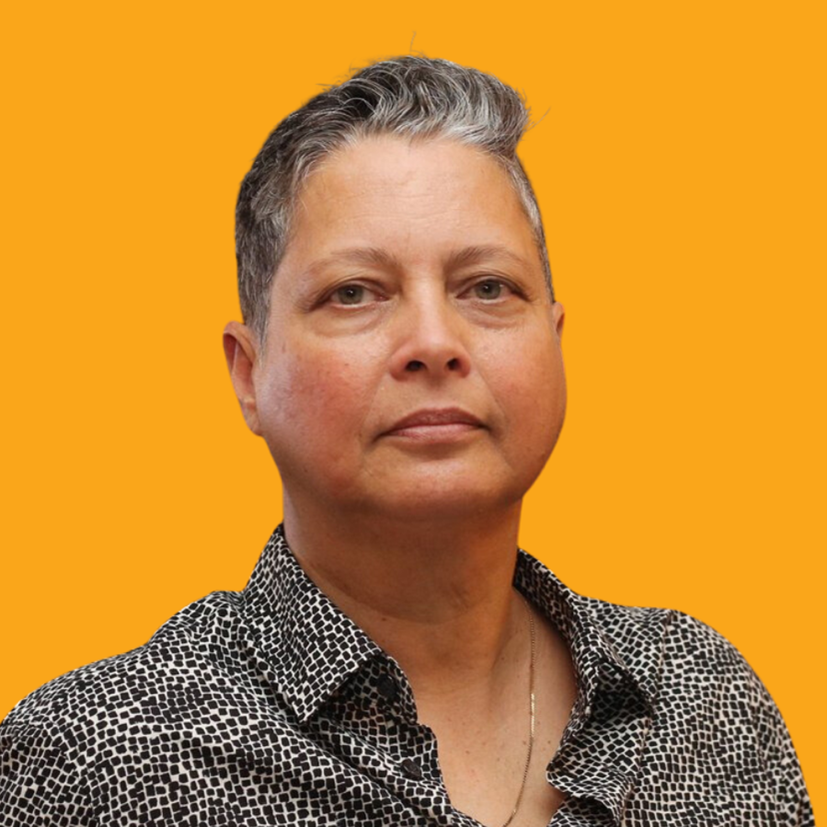 CIVICUS speaks about the status of LGBTQI+ rights and progress being made towards decriminalising homosexuality in Sri Lanka with Rosanna Flamer-Caldera, founder and Executive Director of EQUAL GROUND.
Founded in 2004, EQUAL GROUND is the oldest LGBTQI+ civil society organisation (CSO) in Sri Lanka. It fights for the recognition and realisation of civil, political, economic, social and cultural rights and focuses on empowerment, wellbeing and access to health, education, housing and legal protection services for Sri Lanka’s LGBTQI+ people.
How has the situation of LGBTQI+ rights in Sri Lanka recently changed?
We still have laws inherited from British colonial times that date back to 1883. These are articles 365 and 365A of the Penal Code, which criminalise ‘carnal intercourse against the order of nature’ and ‘acts of gross indecency’. Both of these target LGBTQI+ people.
Sri Lanka is among over 40 former British colonies that also criminalise same-sex sexual relationships between women. In 2018, I filed a complaint with the United Nations (UN) Committee for the Convention on the Elimination of All Forms of Discrimination against Women. In its decision, finally taken in February 2022, the Committee requested that the Sri Lankan government decriminalise homosexuality in general and between consenting same-sex women specifically.
Soon after, in August 2022, a private member’s bill to decriminalise homosexuality was put forward in parliament. In February 2023, in response to Sri Lanka’s Universal Periodic Review at the UN Human Rights Council, where most LGBTQI+ organisations requested the repeal this legislation, the Sri Lankan Minister of Foreign Affairs said that Sri Lanka would follow this recommendation, while making clear it would not legalise same-sex marriage. We understand that’s a fight for another day.
In the meantime, the bill reached the attorney general of Sri Lanka, who released an order that both articles of the Penal Code were to be repealed rather than amended, which made us very happy. But as soon as the bill started being discussed in parliament, a petition was filed claiming it was unconstitutional. There were more than 12 intervening petitions filed to counter this petition, and in response the Supreme Court issued a ground-breaking decision stating that the bill amending the Penal Code to decriminalise consensual same-sex behaviour does not violate the Constitution of Sri Lanka. The case specifically touched upon the concepts of human dignity and privacy underlying equal rights for all, because the preamble of our constitution recognises the value of dignity. The Supreme Court of India used a similar argument in a 2018 case on the right to equality, saying that ‘life without dignity is like a sound that is not heard. Dignity speaks, it has its sound, it is natural and human’.
Now, the bill is up for a parliamentary vote, and all it needs to pass is a simple majority. While the government has said it will decriminalise homosexuality, there are still homophobes in the government. But we hope that the vote will turn out positively.
What role has civil society played in the case?
EQUAL GROUND was among the organisations that submitted petitions in the case that was filed with the Supreme Court. Not only LGBTQI+ organisations, but many other CSOs and individuals also took part in the process. Petitions were also filed by a former UN Special Rapporteur on violence against women and by professors, lawyers, activists and people from all walks of life. The was a lot of positive media coverage, on top of civil society work to create awareness and take to the media to promote the issue.
Of course, there has also been backlash, with some members of parliament attacking the bill and others reconsidering support following a recent Pride march that many thought was not appropriate to Sri Lankan culture due to partial nudity and problematic messaging.
How would you describe relations between Sri Lanka’s LGBTQI+ people and state authorities?
The police have played a huge role in subjugating LGBTQI+ people in Sri Lanka. Not coincidentally, the first event at Colombo Pride 2023 will be devoted to discussing the more than 200 human rights violations against LGBTQI+ people that have been recently recorded in Sri Lanka. In most cases the perpetrator has been linked to the police.
In 2021, EQUAL GROUND filed a case against the police for hiring a motivational speaker who propagated among officers a narrative connecting child abuse and homosexuality. We won the case and the police have been forced to distribute instructions to all police stations alerting officers to be very mindful of their treatment of LGBTQI+ people, particularly transgender people. This has made it clear that asking for sexual favours, blackmailing LGBTQI+ people and stopping them on the streets with no probable cause is against the law.
With the aim of protecting LGBTQI+ people from police brutality, we reopened the case, and the police have recently promised to the court that they will change the terminology to make it inclusive of all LGBTQI+ people. Our strategy was to engage only three LGBTQI+ people along with several heterosexual people, to show the court this was an issue for everyone and not just LGBTQI+ people. Doing it with straight support also showed that not everyone shared anti-LGBTQI+ prejudice. The fact that we filed these cases and got some form of commitment from the authorities was ground-breaking.
Our upcoming Pride march has been sanctioned by the police. We sought their permission, and we’re proud to say that we have been the first organisation to officially get it. Right now, we have a very good Inspector General of Police, he’s easy to talk to, but there’re rumours he will be replaced in three months. I would say there are mixed elements in the current relations between LGBTQI+ people and the authorities.
How does EQUAL GROUND advocate for LGBTQI+ rights?
Our fight, even after decriminalisation is achieved, will continue to aim to integrate LGBTQI+ people into our society. This is the cause we have been working on for the last 19 years.
We’ve held sensitising and educational programmes around the country. We’ve run a lot of social media and mainstream media campaigns, produced research backing our claims regarding the number of people who identify as LGBTQI+ in Sri Lanka and the kind of challenges they face, and have created self-help books for families and allies of LGBTQI+ people. We have an ongoing campaign that has been running for over a year called ‘Live with Love‘, targeted at people who are not haters but are rather neutral or in-between, and could be swayed either way.
All that’s happened over the last 19 years has given rise to many other LGBTQI+ organisations in Sri Lanka that have become involved in advocacy and the struggle for non-discrimination and decriminalisation. When we established our organisation back in 2004, we were the only ones fighting for all LGBTQI+ people, and we remained alone in this journey for a very long time. Only after 2015 did other organisations and people start coming out and getting involved. Until then we lived under a dictatorship and it was difficult to be open, but we have held Pride celebrations since 2004. Our Pride celebrations are turning 19 this year, and so is EQUAL GROUND. We’re very proud of what we have achieved so far.
What forms of international support are Sri Lanka’sLGBTQI+ organisations receiving, and what further support would you need?
We are quite underfunded due to inflation and the ever-rising cost of living, so we aren’t sure that we can retain good staff considering the scale of wages we’re able to pay. We’ve also lost funding due to the fluctuating exchange rate. The state of the economy is one of our major issues, so funding is always welcome.
EQUAL GROUND has been constantly involved in various networks internationally that have opened up avenues of funding and learning, including the International Lesbian, Gay, Bisexual, Trans and Intersex Association (ILGA) and ILGA Asia, Innovation for Change (I4C), and the Commonwealth Equality Network, a network of Commonwealth countries and their LGBTQI+ organisations.
Civic space in Sri Lanka is rated ‘obstructed’ by theCIVICUS Monitor.
Get in touch with EQUAL GROUND through itswebsite or itsFacebook page, and follow@EQUALGROUND_ on Twitter.
-
SRI LANKA: ‘Without international solidarity and support, our democratic hopes will soon be gone’

CIVICUS speaks about Sri Lanka’s protest movement and its repression with student activist Fathima Ashfa Razik. Fathima used to be a university student and a member of the University Students’ Federation of Sri Lanka. She has fled repression and is currently outside the country.
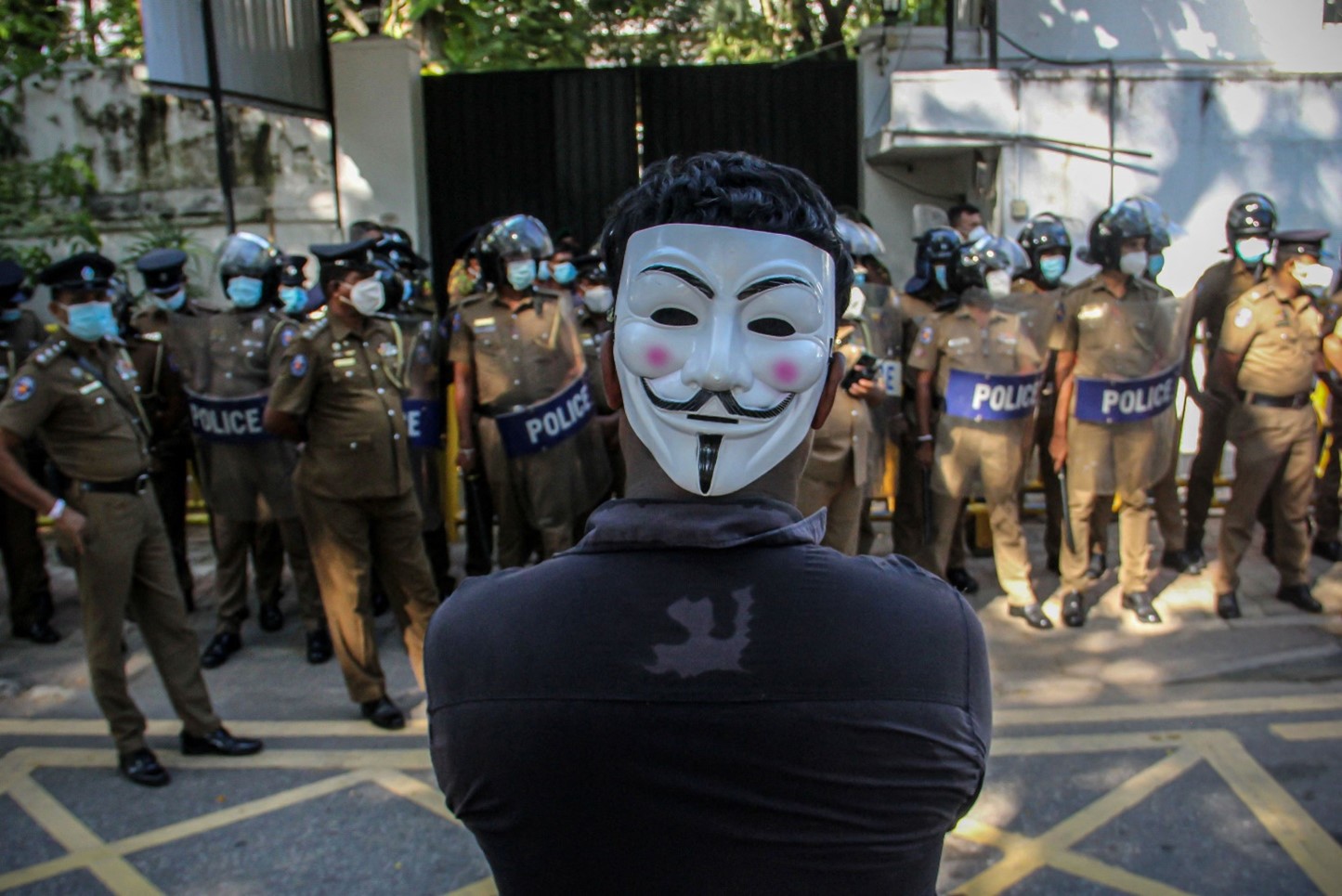
What triggered the mass protests that erupted in Sri Lanka in March 2022?
The protests were triggered by worsening economic conditions caused by negligence and improper management by the government and its leaders. In reaction to this, the university community acted together: students and lecturers from universities all over Sri Lanka organised to protest against the government.
All we wanted was to chase away the Rajapaksa family – then-President Gotabaya Rajapaksa and his several family members who held ministerial positions in the government. They were engaged in looting the country and were becoming a ruling dynasty. We wanted to have them replaced with a new government that would rebuild the nation.
Our protest grabbed public attention and many people joined us in the streets while many others supported us financially. People came together across the religious and racial lines that divided them. This is what made our protest successful. It was recorded as the biggest mass protest in the history of Sri Lanka.
What did the protests accomplish?
Our protest movement started in March and we marched continuously until, one by one, officials from the Rajapaksa family started to resign from their posts. In July the president announced his resignation and absconded to the Maldives and then Singapore, fearing for his life as his personal villa had been seized by protesters in the heat of the action.
The day Gotabaya Rajapaksa left we all won as a nation. We were happy we were able to kick out the rulers that were ruining us.
After the president resigned, power fell in the hands of Ranil Wickremesinghe, which wasn’t what we expected. We wanted a new, younger government that better reflected the hopes of our generation, and instead we got an old politician who had been active in the government for several decades. Wickremesinghe had been reappointed as prime minister by President Rajapaksa in May 2022 and replaced him when he resigned in July.
How did the new government react towards the continuing protests?
At first, the Wickremesinghe government appeared to be aligned with our democratic aspirations, but it soon became clear that this was a facade. Instead of responding to the demands put forward by the protests by focusing on revitalising the economy and rebuilding our institutions, the new government soon started to repress and criminalise protesters.
Within a few weeks of the formation of the new government, President Wickremesinghe commanded the security forces to remove protesters from the area where we were protesting.
And it didn’t stop there: after we were forced back home, the situation only worsened. Many protesters were arrested under the Terrorism Prevention Act (TPA), including the head of our organisation, Wasantha Mudalige, and were subjected to brutal harassment. Many were tortured under detention, and their family members also suffered repercussions and harsh treatment.
Freedom of speech has been suppressed and the people of Sri Lanka have lost their right to live peacefully in their own country. And the underlying issues continue unabated: there has been no change and economic conditions continue to worsen by the day.
What is the current situation?
Repression has increased. Instead of doing their job properly and in accordance with the law, keeping order and protecting people, security forces have become a tool of repression at the service of corrupt politicians.
Law-abiding citizens are not protected by the law: the law is being used against us. This is clear in the way the TPA is being used against protesters and civil society activists.
The government is using this repressive law, and also acting against the law, to suppress the protest movement. Many students and other protesters have been arrested alongside Mudalige.
Due to his high public profile and the international spotlight shining on him, Mudalige is somewhat protected: it would be politically costly to kill him. But unknown protesters are at much higher risk: they can easily become prey to our power-hungry government. Several instances have been recorded recently of missing students and unidentified bodies found floating in water, some with signs of having been tortured. Many more have received death threats, and many have fled.
In the absence of international solidarity and support, there won’t be much of the protest movement left, and our democratic hopes will soon be gone.
Civic space inSri Lanka is rated ‘repressed’by theCIVICUS Monitor.
-
Sri Lanka: Civil society subjected to intensified military surveillance and other restrictions

Joint Statement at the 44th session of the Human Rights Council
Interactive dialogue with the Special Rapporteur on the rights to freedom of peaceful assembly and of association
Thank you, Madam President.
As the Special Rapporteur’s report demonstrates, the space for Sri Lankan civil society is rapidly shrinking. For several months now, civil society organisations have been subject to intensified military surveillance and questioning by different government authorities.
Worryingly, the COVID-19 pandemic has been exploited by the Sri Lankan government to impose restrictions on the rights to freedom of expression, association and peaceful assembly, resulting in the arrest and detention of social media commentators like Ramzy Razeek. Senior lawyer and minority and civic rights activist, Hejaaz Hizbullah, who was arrested and detained on suspicion of offences under the draconian Prevention of Terrorism Act, has now been detained for close to three months without being produced before a judge, after having been misled to believe that the authorities were visiting his house to discuss his potential exposure to COVID-19.
Since January 2020, the Government of Sri Lanka has established multiple Presidential Task Forces. Decisions have been taken with no oversight by Parliament. The Presidential Task Force to build a “Secure Country, Disciplined, Virtuous and Lawful Society” is fully comprised of security sector personnel and given an ambiguous mandate. Sri Lankan civil society has raised a serious concern that the task force can extend military control over civilian life. Its power can be abused to curtail dissenting voices which are deemed to be “harmful to the free and peaceful existence of society”. The increased deployment of military personnel along with the police, and the disproportionate use of force against peaceful protesters, as observed recently, are also alarming.
Considering growing concerns over shrinking space for dissent domestically, the Council remains effectively the only forum where Sri Lankan civil society has the possibility to engage openly in dialogue with the Government and other States on human rights concerns in Sri Lanka, and even this space is increasingly under threat due to deepening risks of reprisals against Sri Lankan civil society actors who speak at the Council. Those human right defenders are increasingly vilified as “traitors” in both mainstream and social media.
Given Sri Lanka’s announced withdrawal from its commitments to the implementation of resolution 30/1, and the clear and consistent recommendations by the OHCHR that the Council should monitor progress towards accountability, the Council needs to take a more robust approach on Sri Lanka. Against this backdrop, we encourage the Special Rapporteur to continue to follow up on the situation and urge the Human Rights Council to enhance its monitoring of Sri Lanka’s compliance with international human rights law, including to ensure that human rights are protected throughout the forthcoming general elections.
Amnesty International
CIVICUS
Forum Asia
Franciscans International
Human Rights Watch
International Movement Against All Forms of Discrimination and Racism
ISHR
Minority rights group international
Civic space in Sri Lanka is currently rated as Obstructed by the CIVICUS Monitor
Current council members:
Afghanistan, Angola, Argentina, Armenia, Australia, Austria, Bahamas, Bahrain, Bangladesh, Bulgaria, Burkina Faso, Cameroon, Chile, Czech Republic, Democratic Republic of the Congo, Denmark, Eritrea, Fiji, Germany, India, Indonesia, Italy, Libya, Marshall Islands, Mauritania, Mexico, Namibia, Nepal, Netherlands, Nigeria, Poland, Pakistan, Peru, Philippines, Qatar, Republic of Korea, Senegal, Slovakia, Somalia, Sudan, Spain, Togo, Ukraine, Uruguay, Venezuela
Civic space ratings from the CIVICUS Monitor
OPEN NARROWED OBSTRUCTED REPRESSED CLOSED -
Sri Lanka: Concerns about missing persons and possible changes to the Constitution
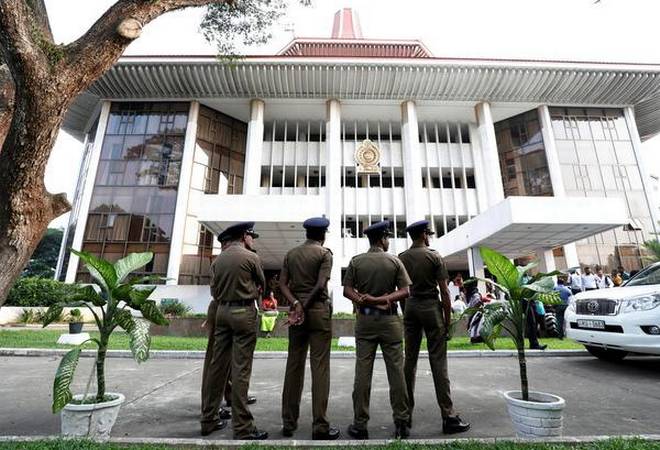
Joint statement at the 43rd Session of the UN Human Rights Council
CIVICUS, IMADR, International Service on Human Rights, Franciscans International, Human Rights Watch, Forum Asia, Minority rights group internationalWe are deeply concerned by indicators of a significant backsliding on human rights in Sri Lanka, underscored by the government using their address to the Council this week to go back on the important commitments made by Sri Lanka through HRC resolution 30/1.
Sri Lankan authorities’ indication to revoke the 19th amendment to the Constitution would remove check and balances on the executive and seriously jeopardise the independence of the judiciary and relevant commissions. The Government is reportedly considering reviewing the Office on Missing Persons (OMP) Act. Similarly, the President’s recent callous comments about the fate of thousands of missing persons without any conclusion of investigations in line with international law have added to the distress of families of the disappeared. A Gazette on 22nd January granted powers to a Commission of Inquiry (CoI) to scrutinise investigations into emblematic cases. The COI has attempted to halt criminal proceedings against navy officers accused of the disappearance and killing of eleven youth. We echo the High Commissioner’s concern on the promotion of several military officers who are named in the OISL report for violations of international law.
Since November 2019, the Ministry of Defence has been assigned as the oversight body for NGOs, significantly increasing the risk of their surveillance. More than a dozen human rights and media organisations have received intimidating visits from law enforcement and intelligence agencies, while death threats against journalists have resumed. The climate of fear has returned to Sri Lanka, in particular among those who continue to call for truth, justice and accountability. Relentless campaigns against minorities also require immediate attention.
We urge this Council to hold Sri Lanka accountable to its obligations under international law. Given this week’s announcement that the new Government will not continue to engage with the clear framework agreed through resolution 30/1; the failure of past domestic reconciliation and accountability mechanisms; and the ongoing compromise of the rule of law as pointed out by the High Commissioner yesterday, we call on the Council to establish an international accountability mechanism on Sri Lanka.
Civic space in Sri Lanka is rated as Obstructed by the CIVICUS Monitor (see country profile page)
-
Sri Lanka: Continued civic space violations and lack of reforms, one year on
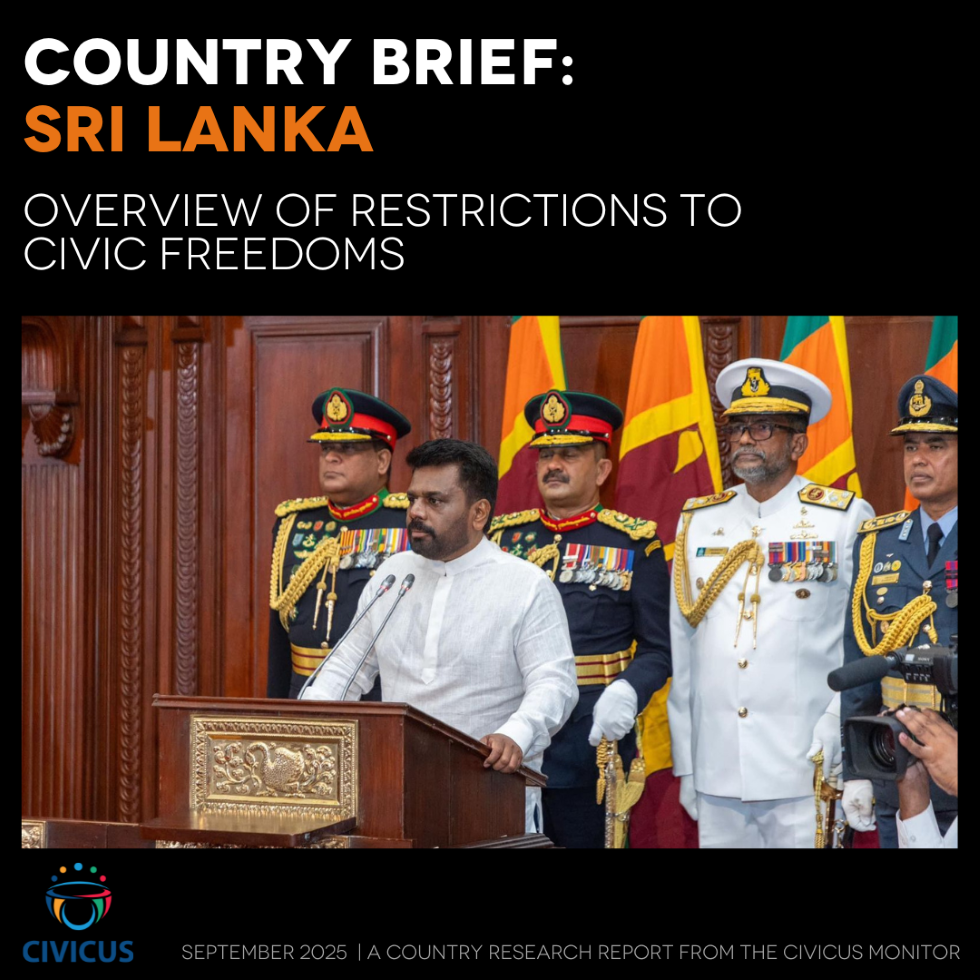
CIVICUS, a global civil society alliance, calls on the government of President Anura Kumara Dissanayake to halt the continued harassment of activists and journalists and crackdown on protests. One year since he came to power, there has been a failure to reform restrictive laws and to address accountability for past crimes.
Some actions, highlighted in a brief published today by the CIVICUS Monitor, are inconsistent with Sri Lanka’s human rights obligations under the International Covenant on Civil and Political Rights (ICCPR). The ICCPR imposes obligations to respect and protect civic freedoms, including freedoms of association, expression and peaceful assembly. These rights are also enshrined in Sri Lanka’s constitution.
The state of civic space in Sri Lanka is rated as ‘repressed’ by the CIVICUS Monitor. Over the last year, the CIVICUS Monitor has documented increasing regulations and onerous bureaucratic requirements for Civil Society Organisations (CSOs) to register and operate, as a result of the militarisation of civilian administrative functions. Further, CSOs are closely monitored by intelligence services, particularly in the north and east where the civil war occurred.
Human rights defenders and activists continue to face intimidation and harassment, while journalists critical of the government, particularly those based in the north and on the east coast, are subjected to ongoing surveillance, harassment, and intimidation by the police and military. There have also been restrictions and arrests of protesters.
"For a year now, the Dissanayake government has continued a troubling legacy of repression, erecting barriers to civil society, harassing those who defend human rights, and silencing critical voices in the media. This crackdown on freedoms must stop. The government must act now to protect the rights of activists and journalists and allow them to work without fear, interference, or retaliation,” said Josef Benedict, Asia researcher for CIVICUS
CIVICUS is also alarmed by the failure to repeal or review restrictive laws to bring them in line with international law and standards. The notorious Prevention of Terrorism Act (PTA) has been used to target perceived opponents and minority communities without credible evidence, despite repeated pledges to end the practice. Furthermore, the Online Safety Act, that is inconsistent with international human rights standards and has sparked fears among rights groups, remains in force. This runs contrary to the promises made by the National People’s Power (NPP), during the presidential elections to abolish the act altogether.
The Dissanayake government has also failed to launch any credible accountability process into the crimes committed during the civil war, despite overwhelming evidence gathered by the UN and human rights groups. Meanwhile, Tamil activists and victim communities continue to face repression and other violations for demanding justice and accountability.
“The authorities must revise or repeal all laws to ensure they comply with the government’s commitment to civic freedoms under the ICCPR. It must also ensure accountability for crimes during the civil war and order all agencies to immediately end all forms of reprisals against representatives of civil society, human rights defenders, journalists, victims and their families, mobilising for justice and accountability.” added Benedict
About the CIVICUS Monitor
Over twenty organisations collaborate on the CIVICUS Monitor to provide an evidence base for action to improve civic space on all continents. Civic freedoms in 198 countries and territories are categorised as itheropen, narrowed, obstructed, repressed or closed, based on a methodology that combines several data sources on the freedoms of association, peaceful assembly and expression.
Civic space in Sri Lanka is rated repressedby the CIVICUS Monitor.
-
Sri Lanka: End Arbitrary Detention of Student Activist

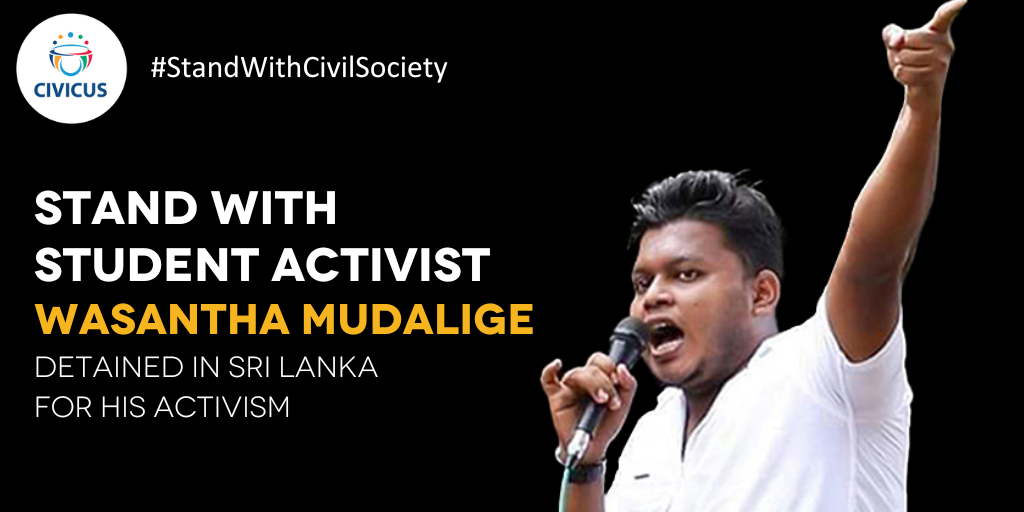 Wasantha Mudalige Held 150 Days Under Draconian Prevention of Terrorism Act
The Sri Lankan government should immediately end the arbitrary detention of Wasantha Mudalige, a student activist who was arrested on August 18, 2022, 7 human rights organizations said today. Since August 21, Mudalige, 29, has been held on orders signed by President Ranil Wickremesinghe under the Prevention of Terrorism Act (PTA), a draconian law that the government has long promised to repeal.
A hearing on Mudalige’s bail application has been scheduled for Hulftsdorp Magistrates Court on January 17, 2023. Under the PTA, the court does not usually grant bail if the Attorney General's Department, acting on the government’s behalf, opposes it.
The Sri Lankan government detained Mudalige as part of its crackdown since an economic crisis in 2022 sparked largely peaceful protests demanding governance reform and action against alleged official corruption. The government responded by giving sweeping powers to the police and military, which used unnecessary and excessive force to disperse demonstrations and arrest hundreds of people, including many students.
Many of those detained have since been released on bail. However, the authorities have used extraordinary powers under the Prevention of Terrorism Act to keep Mudalige in detention despite having produced no evidence of any involvement in “terrorism.” As convenor of the Inter University Students' Federation, he had taken a prominent part in the protests. Much of the time he has been held in solitary confinement and poor conditions, which can violate the prohibition on torture or other ill-treatment under international human rights law.
In December, Mudalige required hospital treatment for breathing difficulties. His family and his lawyer have expressed concern for his safety and his health in detention. On October 4, the Human Rights Commission of Sri Lanka issued a notice calling for the police to protect Mudalige’s safety in custody.
The Prevention of Terrorism Act allows for up to a year of detention without charge on the orders of the defense minister, who is currently President Wickremesinghe. Since it was introduced as a “temporary” measure in 1979, the law has been used particularly to target members of the Tamil and Muslim communities, and to stifle dissenting voices including journalists and human rights defenders. The United Nations and human rights groups have repeatedly documented that the PTA has been used to enable prolonged arbitrary detention and torture or other ill-treatment.
Successive Sri Lankan governments, including the present administration, have repeatedly pledged to repeal the PTA and replace it with rights-respecting legislation – most recently to the European Union in October. Yet the government continues to use the law to violate human rights, in breach of its own domestic and international commitments.
On August 18, the authorities arrested Mudalige along with 19 other people during a protest in Colombo that the police violently disrupted using excessive force. Two others arrested that day were also detained under the PTA, but both have since been released without charge. Hundreds of people arrested under ordinary criminal legislation for offenses allegedly committed during the 2022 protests, such as damage to public property, have also been released on bail.
During the first three months of his detention, Mudalige was shuttled between two detention centers run by the police Terrorism Investigation Department. One is a dilapidated and abandoned prison unfit to hold prisoners. He and the other detainees were held in solitary confinement, in cramped cells without access to basic facilities including sanitation and sunlight. Holding people in such conditions violates the international legal prohibition on torture or other cruel, inhuman or degrading treatment. Prisoners suffered ill health, apparently as a result of the conditions in the jail and lack of treatment.
The abuse of counterterrorism legislation to arbitrarily detain a student activist involved in non-violent protest has a chilling effect on the rights to freedom of expression, association and peaceful assembly, the groups said. President Wickremesinghe has called anti-government protesters “terrorists” and “fascists,” and threatened to renew a state of emergency and redeploy the military if fresh protests emerge amid the ongoing economic crisis. The authorities have continued to pursue other activists alleged to have participated in the 2022 protests.
On December 14, Mudalige was taken before a magistrate for the first time since he was detained. The magistrate ordered the attorney general to submit any evidence against Mudalige at the next hearing, on January 17, or to agree to bail. On January 5, the police took Mudalige before a magistrate and introduced new cases against him under ordinary criminal laws, related to other protests in which he purportedly participated in 2022.
The authorities have targeted Mudalige in the past for his activism. On August 3, 2021, he was arrested and jailed for more than three months after protesting for the right to free education. Thirteen human rights organizations issued an appeal against his detention.
The Sri Lankan authorities should immediately impose a moratorium on the use of the PTA, and promptly repeal it, the groups said. The authorities should immediately review the detention of anyone held under the PTA, ensuring adequate access to fair bail hearings. They should also release all protesters facing charges that do not meet international standards.
The government of Sri Lanka should fully respect the rights to freedom of expression and peaceful assembly.
Signed:
Amnesty International
Asian Forum for Human Rights and Development (FORUM-ASIA)
CIVICUS: World Alliance for Citizen Participation
Frontline Defenders
Human Rights Watch
International Working Group on Sri Lanka
Sri Lanka Campaign for Peace and Justice
Civic space in Sri Lanka is rated as Obstructed by the CIVICUS Monitor
-
Sri Lanka: Human Rights Under Attack
Lawyers, Human Rights Defenders and Journalists Arrested, Threatened, Intimidated
-
Sri Lanka: Lift restrictions on fundamental freedoms and investigate violations
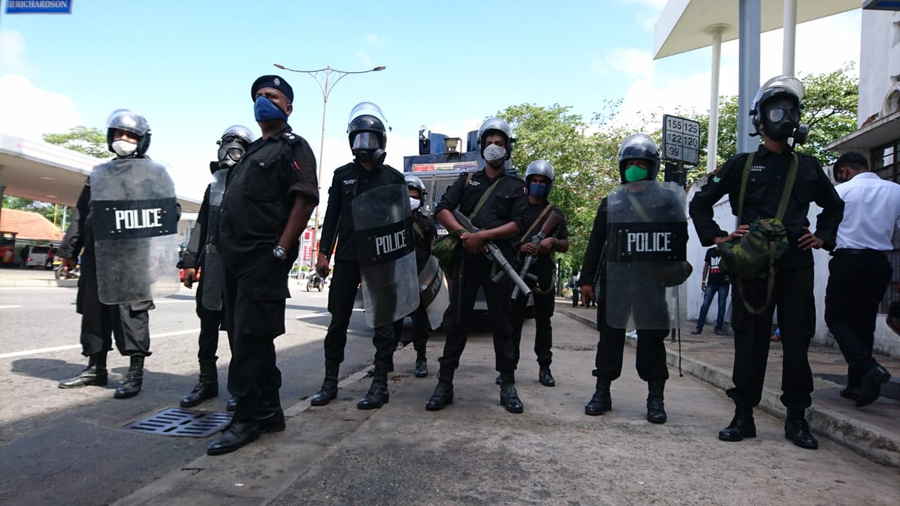
CIVICUS, a global civil society alliance, is alarmed by the declaration of a state of emergency in Sri Lanka, the excessive use of force by the Sri Lankan security forces against protesters and restrictions on internet access following widespread demonstrations in the country.
There have been anti-government protests since early March 2022 as the country suffers its worst economic crisis in decades. Demonstrators accuse the government of mismanaging the economy and creating a foreign exchange crisis that has led to shortages of essentials such as fuel, cooking gas, milk powder and medicine.
Hundreds of protesters marched outside President Gotabaya Rajapaksa’s private residence on 31 March 2022. The peaceful protests turned violent when security forces deployed tear gas and water cannons leaving at least 50 injured. Dozens of protesters were arrested and some ill-treated. Eight journalists who were covering the protests were allegedly assaulted by security forces.
On 1 April 2022, a state of emergency was declared by the president in an effort to quell the protests. It allows authorities to arrest and detain suspects without warrants, and this severely restricts fundamental rights such as the freedoms of expression and assembly. Under the state of emergency, the authorities imposed a nation-wide 36-hour curfew. Despite this, thousands of protesters, including students, continued to take to the streets. According to reports at least 600 protesters were arbitrarily arrested on 2 and 3 April.
“Sri Lanka’s clampdown on civic space with the imposition of a state of emergency is extremely worrying. We urge the government to refrain from deploying violence against protesters and instead respect and protect peoples’ rights to peaceful protest. All those detained arbitrarily must be released and all abuses by security forces must be investigated and punished,” said Josef Benedict, Asia Pacific Researcher of CIVICUS.
The government has restricted internet access and social media platform for nearly 15 hours under the pretext of maintaining public and social order. On 2 April 2022, Thisara Anuruddha Bandara, a youth activist who actively promoted the #GoHomeGota social media campaign to oust the president - used widely during the protest - was arrested for allegedly ‘exciting disaffection’ against the president under Section 120 of the Penal Code. He was granted bail a day after.
“The government must halt any restrictions on internet access, including to social media platforms, which is a clear violation of the right to freedom of expression and information guaranteed by the constitution and under international human rights law. The authorities must also drop the charges against youth activist Thisara Anuruddha Bandara immediately,” added Josef Benedict.
CIVICUS has documented how the Rajapaksa administration has led an assault on civic space and fundamental freedoms since the President assumed power more than two years ago. There have been ongoing attempts to prevent and disrupt protests. This included imposing a ban on all protests under the pretext of COVID-19, arbitrary arrests of peaceful protesters and activists using the draconian Prevention of Terrorism Act (PTA), as well as criminalising dissenters. In March, the UN High Commissioner for Human Rights, Michelle Bachelet, similarly reported to the Human Rights Council that ‘the Government’s response to criticism has constricted democratic and civic space’.
As the party to the International Covenant on Civil and Political Rights (ICCPR), the Sri Lankan government has the duty to respect, protect and fulfil fundamental freedoms enshrined under the treaty. This includes the right to freedom of expression and peaceful assembly. Any use of force must only be the minimum amount necessary, targeted at specific individuals, and proportionate to the threat posed.
The protests and escalating economic crisis has led to the resignations of 26 ministers in the current cabinet leaving only the president, Gotabaya Rajapaksa, and his brother, Mahinda Rajapaksa, the prime minister.
Civic space in Sri Lanka is rated as obstructed by the CIVICUS Monitor.
-
Sri Lanka: Release poet and drop spurious charges against him
Joint Statement from CIVICUS and Asian Human Rights Commission (AHRC)
The arrest and ongoing detention of award-winning author and poet Shakthika Sathkumara on spurious charges are a clear violation of his right to freedom of expression, CIVICUS, the global civil society alliance and the Asian Human Right Commission (AHRC), said today ahead of his next court hearing on 18 June.
Shakthika Sathkumara was arrested on 1 April 2019 by the Polgahawela Police in response to a complaint alleging that Sathkumara’s short story ‘Ardha’ (Half) was derogatory and defamatory to Buddhism. The story is allegedly about homosexuality and child abuse in a Buddhist temple in Sri Lanka, and there is no evidence that the content contains anything that amounts to hate speech or defamation. He was initially remanded by the Polgahawela Magistrate’s Court until 9 April and has remained detained since his arrest. The Attorney General has twice rejected his bail request.
Sathkumara faces charges under the International Covenant on Civil and Political Rights (ICCPR) Act of 2007, which criminalises the advocacy of “national, racial or religious hatred that constitutes incitement to discrimination, hostility or violence”. If convicted, he faces a maximum of up to ten years’ imprisonment. No credible evidence has been presented to substantiate any of these charges.
This is a clear misuse of the law, which was enacted to protect human rights recognised by the international community including fundamental freedoms such as freedom of speech.
Shakthika Sathkumar’s arrest and ongoing detention are inconsistent with Sri Lanka’s constitutional and international human rights obligations, as well as the country’s ICCPR Act. The right to freedom of expression which includes artistic expression and creativity is guaranteed under the International Covenant on Civil and Political Rights, to which Sri Lanka is a party, as well as Article 14(1)(a) of the Constitution of Sri Lanka. Sri Lanka is also bound by international human rights law to protect artists and all persons participating in artistic activities.
Further, under the law he can only be granted bail by a high court judge. Systemic delays inherent in the Sri Lankan justice system means that it could be months before he even appears before a high court. That he has been remanded only on the basis of a police report, without a magistrate ruling that there is basis for detention, is also a violation of fair trial rights and has worrying implications for due process rights in the country. The Inspector General of Police and the Attorney General of Sri Lanka must investigate these concerns immediately.
CIVICUS and AHRC call on the authorities to release Shakthika Sathkumara immediately and unconditionally, and to drop the spurious charges brought against him. We also call on the authorities to ensure that writers and artists may work freely and without fear of retribution for expression critical opinions or covering topics that the government or others may find sensitive or offensive.
Shakthika Sathkumar’s arrest comes in the context of attacks on civic space more broadly in the country. Over the last year, CIVICUS has documented multiple attacks, threats and intimidation against journalists and human rights activists in Sri Lanka and the failure to bring the perpetrators of these abuses to account.
TheCIVICUS Monitor, an online platform that tracks threats to civil society in countries across the globe, rates the space for civil society inSri Lanka as ‘Obstructed’
For more information, please contact:
Josef Benedict at josef.benedict{AT}civicus.org (CIVICUS) or
Mohammad Ashrafuzzaman at zaman{AT}ahrc.asia (AHRC) -
Sri Lanka: Space for civil society continues to be under attack

Statement at the 53rd Session of the UN Human Rights Council
Adoption of the UPR report of Sri Lanka
Delivered by Tharindu Jayawardhana
Thank you, Mr President.
Mr President, the Centre for Society and Religion, Asia Legal Resource Centre and CIVICUS welcome the government of Sri Lanka's engagement with the UPR process.
Since its last review, Sri Lanka did not implement any of the nine recommendations related to civic space. We note that Sri Lanka accepted 24 of the 31 recommendations on civic space it received during this cycle including to ensure a safe environment for civil society, including human rights defenders and journalists and refrain from imposing undue limitation on NGOs.
Despite these commitments, space for civil society has continued to come under attack in recent years. We have documented arbitrary arrests, detention, harassment and surveillance of activists and journalists and the misuse of the PTA and ICCPR Act and other laws to silence freedom of expression and assembly. We also documented restrictions on protests and harassment and intimidation of protesters - including against families of disappeared persons in the north and east - and the use of excessive force and prosecution of protesters following the economic crisis. We are concerned the imminent “NGO law” will curtail freedom of association and legalize government interference in civil society.
Mr President, our organisations call on the Government of Sri Lanka to withdraw charges against activist and lawyer Hejaaz Hizbullah charged under the PTA; discharge activist and comedian Nathasha Edirisooriya facing several court cases including under the ICCPR Act; to discharge protesters facing court cases related to protests under various laws and to conduct impartial investigations and prosecutions in relation to violations committed by police and armed forces in the context of protests and repeal all draconian legislation used to criminalise activists.
We thank you.
Civic space in Sri Lanka is rated as "Obstructed" by the CIVICUS Monitor.
-
Sri Lanka: Two years on, escalating assault on freedoms by the Rajapaksa administration

Two years on from the election of Gotabaya Rajapaksa as President of Sri Lanka, the state of civic freedoms in the country continues to regress. Research undertaken by the CIVICUS Monitor – which rates civic space in Sri Lanka as ‘obstructed’ – shows a worrying pattern of increasing restrictions on freedom of expression, assembly and association, often with impunity.
-
ST VINCENT AND THE GRENADINES: ‘We advocate for the repeal of anti-gay laws as a matter of human dignity’
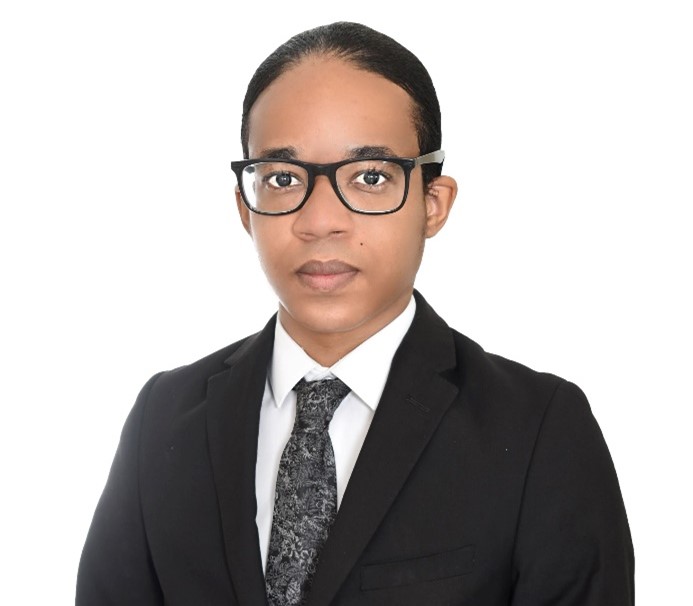
 CIVICUS speaks about struggles for LGBTQI+ rights and a recent legal setback in St Vincent and the Grenadines (SVG) with Jeshua Bardoo, founder and Executive Officer of Equal Rights, Access and Opportunities SVG (ERAO SVG).
ERAO SVG is an intersectional human rights civil society organisation (CSO) that promotes equality and non-discrimination in SVG. It conducts research and monitors human rights and social justice issues affecting women, children, LGBTQI+ people and people with disabilities. It carries out public awareness campaigns, advocates with local and national authorities, as well as in regional and international rights forums, convenes like-minded organisations, organises consultations and provides training on human rights issues affecting its target populations.
How do LGBTQI+ organisations in SVG, including ERAO SVG, defend and promote the rights of LGBTQI+ people?
Human rights advocacy, particularly for LGBTQI+ rights, has limited visibility in SVG. There are few organisations working for LGBTQI+ rights, and ERAO SVG is among the main ones. Other groups, such as VincyChap and Care SVG, work on HIV/AIDS and contribute indirectly to supporting LGBTQI+ people. Notably, VincyChap participates as an interested party in consolidated court cases challenging anti-LGBTQI+ laws. ERAO SVG, while not involved at the inception, now supports the case.
Focusing on education and awareness, ERAO SVG conducts in-person and online events to sensitise people on queer rights and focuses on tackling stigma. Last year we organised historic Pride celebrations alongside the Resident British Commissioner’s Office. Events included a Pride SVG reception, workshop, panel discussion and a social media campaign.
Despite the challenges and risks, our efforts seek visibility for LGBTQI+ people in SVG. Collaborations with local, regional and international organisations enhance our impact. As part of our commitment to bringing about change, we worked with Human Rights Watch to produce a report that highlights the community’s challenges and issues a series of recommendations.
Have you experienced backlash?
I have faced significant backlash in my activism for LGBTQI+ rights, both online and offline. Negative reactions, to the point to trigger depression, intensified in 2019 after I published an article, ‘Do black LGBTQ+ Vincentian lives matter?’. Despite the discouragement, I went back to writing and advocating for human rights and queer rights.
Public events, especially Pride celebrations, always trigger backlash, particularly from members of the Thusian Seventh Day Adventists, a Christian group, who continuously publicly call me out on social media. Also, someone on the radio called for my arrest following the recent court ruling that upheld anti-LGBTQI+ laws in SVG.
Social media posts warning LGBTQI+ visitors about the risks they would face in SVG helped us get some attention but also attracted criticism. Despite the online hostility, to date I have faced no actual physical harm, although the threats I received right after the court ruling made me fear I would. To protect my mental wellbeing, I now try to avoid reading negative comments I receive on social media.
The backlash and how busy I became after the recent ruling took a toll on me mentally, making me physically exhausted. I plan to take a break to recover but I remain committed to my advocacy. My experiences growing up as a queer person in a hostile environment, including discrimination in school and religious settings, have shaped my resilience. I now choose a religion that predicates love, distancing myself from past religious affiliations.
How much of a setback is the recent legal court ruling that upheld anti-LGBTQI+ laws in SVG?
It was very disappointing. In 2019, two gay Vincentians, Javin Johnson and Sean MacLeish, challenged SVG’s so-called anti- LGBTQI+ laws, sections 146 and 148 of the Criminal Code. Both petitioners live abroad. Johnson sought asylum in the UK while MacLeish lives in the USA. Their petition argued that their constitutional rights were being violated, including the rights to privacy, personal liberty and protection from discrimination. They claimed they had left SVG due to the severity of its anti-LGBTQI+ legislation, which made it impossible for them to live in the country as gay men.
CSOs such as VincyChap in SVG supported the case, while the UK-based organisation Human Dignity Trust played a role in the background.
However, on 16 February 2024 the court questioned the claimants’ standing and ruled that none of their rights had been violated. It deemed the LGBTQI+ laws justifiable, citing public health concerns related to HIV and morality. As it dismissed their claims, the court didn’t offer any remedy and ordered each claimant to pay EC$7,500 (approx. US$2,800) to the state in legal costs.
There are still other legal cases in the region awaiting decisions, and despite setbacks, civil society activists and organisations remain committed to challenging discriminatory laws.
What are the next steps following this disappointment?
After studying the ruling and the justifications it offers, the lawyers and claimants in the case will decide whether to appeal. They need to weigh whether loopholes or weaknesses in the ruling provide grounds for a potentially successful appeal. Personally, having followed the virtual court proceedings, I find many of its statements absurd and believe the case should be appealed or otherwise new cases should be filed.
We are disappointed that Prime Minister Ralph Gonsalves has failed to address the issue, which I think reflects state-sanctioned homophobia. Despite past condemnations of violence against LGBTQI+ people, there has been no practical action. It is disheartening to see politicians so focused on keeping the support of Christian voters who are allegedly in the majority. It is worth noting that churches were deeply involved in the judicial case. The judge’s open expression of religious sentiments and allegiances in court raised serious doubts about her impartiality.
Governments should prioritise people’s wellbeing, and in the case of LGBTQI+ people, this requires at the very least repealing criminalising provisions. The state should also enact comprehensive legislation protecting people from discrimination based on sexual orientation and gender identity and expression. There is nothing like this in SVG, so there is a lot of work to be done. As a first step, ERAO SVG will continue to advocate for the repeal of discriminatory laws as a matter of human dignity.
Civic space in St Vincent and the Grenadines is rated ‘open’ by theCIVICUS Monitor.
Get in touch with ERAO SVG through itswebsite orFacebook page, and follow@eraosvg on Instagram.
-
Standing in solidarity with Venezuelan human rights defenders

The recent, ongoing and unwarranted detention of five members of the Venezuelan NGO ‘Azul Positivo’ is one more event in a series of threats, harassment, attacks, restrictions, reprisals and criminal proceedings against Venezuelan civil society organizations and human rights defenders, which has been intensifying since November 2020. In recent months and weeks, state agents have forcibly entered the offices of civil society organizations; public threats have been made against defenders who have been engaging with human rights mechanisms, NGO bank accounts have been frozen and arrest warrants issued for aid workers.
-
State of civil society in Equatorial Guinea: An interview with CEID
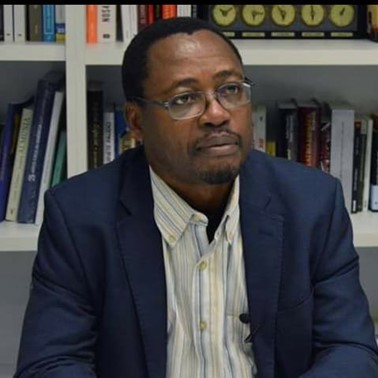
CIVICUS speaks to Alfredo Okenve, board member in charge of the International Cooperation and Good Governance Programmes of the Centre for Development Studies and Initiatives (CEID). Since 2012 Okenve coordinates the network of national CSOs in Equatorial Guinea. Trained as a physicist, he is a human rights defender and social activist with more than 20 years’ experience in consulting and management of development and civil society projects in Equatorial Guinea. He has worked as a professor of Mathematics and Physics and held a managerial position at the National University of Equatorial Guinea.
1. The government of Equatorial Guinea is among the worst human rights abusers in the world. How would you describe the environment for civil society activity in the country?
Civil society is still fledgling in Equatorial Guinea. It dates back to the nineties, and it faces internal difficulties such as a lack of tradition and experience in development and human rights work. It does not have much institutional support either - neither external nor domestic. However, the greatest among its current challenges lies with Equatorial Guinea’s government system. The ruling regime does not uphold any fundamental right, including the right to freedom of association enshrined in our Constitution. The environment is unfavourable, even hostile, to civil society work in every respect (the law, actual practices, lack of respect for human rights, funding, etc.). And it is particularly so for independent groups such as our NGO. There is a long list of legally recognised organisations in the country, but this basically serves the government to show that it respects the right to free association. In practice, however, the Ministry of the Interior stigmatises those organisations that want to work for the country’s development without following its orders, by arbitrarily attributing them uncivil actions. It has even suspended by decree the activities of NGOs like CEID, our organisation, or AGECDEA, another organisation dedicated to the “dangerous” task of providing solidary support to the elderly.
The situation has not improved in spite of the many civil society initiatives directed at the government to foster dialogue, improve the environment for civil society and promote human rights and the fight against poverty. On the contrary, in recent years Equatorial Guinea has been increasingly militarised, as if we were living under a state of siege.2. What are the obstacles limiting the freedom of association in Equatorial Guinea? How have they affected you and your organisation?
Domestic laws and administrative practices are very restrictive. On one hand, the process for the legalisation of an organisation is long and full of obstacles. For example, it requires the organisation’s promoters to submit to the Ministry of the Interior an affidavit certifying that it will submit to its control on a quarterly basis, plus a favourable report from the Ministry of the area in which the organisation wishes to work, and another report from the governor or provincial government delegate. It also requires them to formalise the constitution of the entity before a notary public, who in turn must obtain an authorisation from the Ministry of the Interior to validate this act. No legally constituted association is allowed to receive any donation, whether local or foreign, private or public, above a hundred US dollars without prior authorisation from the Interior Minister. Another example: no legally constituted organisation, that is, no organisation that has been allowed by the government to function, can deal directly with a beneficiary community without an additional authorisation or credential; this is not what the law says, but it is “customary”.Additionally the government routinely threatens the members of those organisations that are considered to be “enemies of the fatherland”, that is, those that are not aligned politically with the government. Last December, the governor of the Litoral province, where our headquarters are located, gathered all regional and provincial authorities and urged them not to interact with our NGO since their Ministry is in charge of the third sector, and the Minister had decreed our suspension.
Personally, as a professor and staff of the National University, I have not received my salary and have been arbitrarily and illegally banned from doing my job since June 2010, despite a shortage of teachers –all because of my condition as a social leader, human rights defender and good governance activist. What they are trying to do is condemn me to social exclusion and thereby send a warning to forcefully discourage civil society.
From 2015 on, the country’s CSOs have submitted to the government joint proposals to reform the laws of associations, indicating the limitations that the current law imposes on our social work; we have also raised the need for a national forum or conference on the role of civil society in the country. We have not yet received any official response.3. Equatorial Guinea has one of the lowest Internet penetration rates in Africa, and online censorship is routine. How do you manage to get your work done when the freedom of expression and information is so restricted?
Internet access remains a problem for us, either because of the low technology level or the lack of telematics capabilities of the country, or because of blockages imposed on critical websites or social networks such as Facebook or Twitter –coupled with electricity supply problems in most of the country.
Internally, we have no choice other than try to bypass and endure these obstacles, but it is indeed difficult and it restricts our work capacity. At the organisational level, we have adopted the strategy of opening spaces for information and coordination among our country’s civil society organisations, notably the National Coordination of CSOs, a platform and meeting point for the solidarity action of civil society.4. Are protests allowed in Equatorial Guinea? How are citizens treated when the try to protest?
Our Constitution recognises the right to strike and demonstrate. The written rules state that a notification to the government authorities would suffice to exercise this right. In practice, however, the only demonstrations that are allowed and that are actually taking place in our country are those of support and praise to the President of the Republic and his policies –that is to say, those that are summoned by the government or the PDGE (Democratic Party of Equatorial Guinea), the ruling party. Anyone promoting a demonstration against the government policies or any other form of expression, even the mere distribution of information leaflets in the streets, generally ends up under interrogation, tortured, imprisoned and/or dismissed from their jobs. Any claim or remedy that is filed with the competent authority in this regard is either denied or ignored. I think the situation is similar to that of closed regimes such as North Korea’s.5. What are CEID’s aims? How does the organisation do its work within this context?
CEID is a not-for-profit, non-denominational and independent organisation. It began to form in 1996, at a time when our country was, despite its plentiful resources, among the most underdeveloped countries in Africa. It originated out of the concerns of a group of young graduates from several European universities (mostly Spanish and Russian), coming from fields as diverse as International Cooperation, Journalism, Economics, Engineering and Medicine. All of us wanted to contribute from civil society to improve the living conditions and the prospects for development of their fellow citizens, and were convinced that fostering a responsible, conscious, participative and enabled citizenry was of the utmost importance. And we shared the idea that the only real form of development is human, inclusive, sustainable and integral development. We wanted to dedicate our time to volunteer but professional work to fight against poverty and marginalisation through research and cooperation. The NGO was set up in Malabo in April 1997, and only by the end of 1998 did we obtain the authorisation to operate in the country.We started working to identify the development problems of our country, analysing possible solutions from civil society. As a result, we set out at the grassroots level with two important programmes: the Civil Society Strengthening Programme and the Local Community Development Programme. A large part of our interventions were designed around these programmes. But we found out that international funding was in retreat because Guinea had become, thanks to its fossil fuel production, a middle-income country –even though our government had no intention or will to use any of that income to fund development through non-governmental entities. The ruling regime, which is totalitarian and based on monolithic thinking, never liked the sight of actors out of its orbit venturing on the national stage. There were plenty of attempts to co-opt our leaders, with diverse degrees of success. For all of these reasons, two years after we were granted legal personality we went through a crisis that led us to total hibernation lasting for about six years. We resumed our activities in 2007-2008, and now our priorities include human rights and good governance, issues that were prohibited to us by law until 2006. We also found some timid international support.
In sum, our work has focused on the introduction of new information technologies in education, local community and rural development, good governance and, above all, the strengthening of civil society. Since its inception five years ago, CEID leads the National Coordinating Network of Civil Society Organisations. We have also done consultancy work with international development and cooperation organisations and programmes.We have a Board of Directors that is renewed every three years, and we gather in members’ assemblies every 18 months. Our headquarters are located in Bata, the country’s second capital. We cover our operating expenses and minor projects with the fees paid by our members-partners and the odd consultancy job; for development projects of a certain magnitude, of which we have already executed (or are in the process of implementing) fourteen, we seek external funds. So far all of these funds have come from the few international cooperation agencies that are still active in the country, or from occasional consortia with extractive industries fulfilling their commitment to corporate social responsibility. We have never received a single dollar from the State of Guinea.
Most CEID members are public servants and our dedication to NGO work is voluntary. This leaves us in a situation of great vulnerability, as we appear as easy prey for harassment, threats and blackmail. Nevertheless, we try to find courage in the conviction that we are doing something that is very necessary and, generally speaking, unprecedented. So far we have managed not to deviate from our ideas.
Unfortunately, we don’t have any self-protection strategy in place. The constant restrictions we face, plus the challenge of overcoming them while working on the ground in order to fulfil our commitments have left us no time or capacity to establish much-needed contingency policies. We therefore just try to always work within the legal framework and to appeal to the legality of all our actions.As we lack the capacity to directly execute many of our initiatives, we usually submit them as suggestions to the institutions that are in a position or whose job it is to implement them. That is why we are always encouraging meetings and advocacy with government institutions such as those in the good governance sector (human rights, transparency) and in social sectors such as education, health and children’s care. We take a similar stance towards other NGOs that we have been providing training to. In 2011 we founded the Coordinating Network along with sectorial sub-networks to join efforts and promote collective initiatives. CEID plays a very active part in the tripartite EITI (Extractive Industries Transparency Initiative) National Commission, created in 2007, in representation of civil society. It is a challenge for Guinean civil society to have its own space recognised and for NGOs to be treated as development actors in their own right.
6. What can domestic actors do to promote respect for human rights and a healthy civic space in Equatorial Guinea?
We believe that the steps that we are already taking are the right ones and we need to work to improve them, because they are based on participatory strategies. Despite the obstacles and restrictions faced by Guinean civil society, we struggle to conquer spaces. Lobbying, advocacy and perseverance are as necessary as increased cohesion and solidarity. An example of the steps we have taken is the creation, within the Coordinating Network, of sectorial groups and specifically one for Human Rights and Transparency. On the same line of action, through the national information media CEID has been able to keep over the past four years a one-hour weekly radio space from which to promote respect for human rights, social involvement and public spiritedness. Likewise, we have proposed to the Ministry of Education the introduction of the subject of civic and social education within the national school curriculum.7. How can external actors, including regional organisations and international solidarity movements, support civil society in Equatorial Guinea?
Civil society organisations in Equatorial Guinea need not just financial but also human, technical and institutional support from regional and international organisations. We need management tools and training on issues related to the development of civic spaces in restrictive environments, and to the role of civil society in the struggle for the rule of law and against poverty. We need to be wrapped up in solidarity and not be left alone; we need international actors to integrate us into their sub-regional, regional and global networks and to advocate for us with their governments, which maintain relations with Equatorial Guinea, so they put pressure on ours to provide a favourable environment for civil society.Civic space in Equatorial Guinea is rated as ‘closed’ by the CIVICUS Monitor.
Get in touch with CEID through their website or visit their Facebook page. -
Statement at Human Rights Council: Threats to civic space
37th Session of the UN Human Rights Council
Oral StatementRestrictions of civic space and threats to human rights defenders is fast spreading in the Global North as well as the South. From Hungary, Russia, Turkey, Bulgaria to Ethiopia, Rwanda, Uganda, Egypt the threats are similar.
Threats to civic space and human rights defenders
According to the CIVCUS Monitor, in 2017 just only two percent of the world’s population live in a country with ‘open’ civic space. In Africa, only 2 countries are considered to have open civic space, while 52 are rated either as ‘closed’, ‘repressed’, or ‘obstructed’.
- Governments are involved in smear campaigns against civil society, seeking to undermine their credibility and legitimacy in the population. The attacks include accusations of being agents of foreign power, interference in political matters, conducting subversive activities and involvement in money laundering.
- Access to resources is being restricted in the guise of controlling terror financing and illicit wealth. Under pressure from governments, financial institutions have set intrusive and obstructive requirements for banking by civil society including deposit of donor contracts, work plans among others. In some countries, foreign donations are either banned or limited to percentages that cripple the work of the civil society, that is largely funded by donations.
- Regulations are being passed that create burdensome registration requirements, criminalises unregistered and informal forms of organising and giving vague and wide powers to government bodies to deregister civil society groups on such grounds as ‘acting against the interest of the people’. In many cases, these restrictions are intentionally aimed at stifling independent NGOs because they defend minority groups, and allow all sections of society to participate in decision-making.
Reprisal against human rights defenders
Around the continent there are increased reports of reprisal attacks, human rights defenders.
- In Uganda, Action Aid International Uganda and three other organisations had their accounts frozen in October 2017 by the government for over three months for leading a campaign against a change in the constitution that would undermine land rights of local communities.
Reliance of civil society and HRDs
The challenges notwithstanding, civil society groups have demonstrated remarkable resilience. As of September 21, 2017, the CIVICUS Monitor had documented 42 reports where this activism led to positive civic space developments.
- In Jan of 2018, Mali became the third Africa country after Côte d’Ivoire (June 2014) and Burkina Faso (June 2017) to enact a law on the protection of HRDs.
- In South Africa, the High Court, Western Cape Division, Cape Town in case filed by HRD and in which the UN SP FoAA filed an amicus, ruled that the notification provisions of South Africa’s Gatherings Act constitute “illegitimate” restrictions on the right to freedom of peaceful assembly
In light of the above and also in celebrating the unanimous adoption of the GA Resolution on HRDs last November we recommend the Council to:
Recommendation to the Human Rights Council
- Encourage special procedure mandate holders to support or file cases for litigation in national and regional courts to challenge laws and regulations that threaten civic space and the work of human rights defenders. They can bring their expertise to the assistance of municipal courts.
- Engage States to grant long term, as opposed to short term mandates, to the UN Human Rights Country offices because they are important in building the capacities of local civil society and the protection of human rights defenders.
- Document cases of reprisals against human rights defenders and encourage the enactment of HRD laws